Man vs. Bear Print
“Man vs. Bear” began with a viral hypothetical question. If you were alone in the woods, would you rather encounter a man or a bear. The overwhelming response from women was bear, because a bear is violent only to survive. A bear is dangerous, but predictable. A dangerous man is not.
This painting explores what Eve symbolizes, her legacy and her influence on how women are seen today. The mother of mankind, born of Adam and the first to sin. Her shame manifests in the pain of childbirth and menstruation. Before Abrahamic religions dominated the planet, ancient societies also worshiped the earth and the goddess. There is a tendency to think that homo sapiens are patriarchal animals but this is simply not true. Much of what is considered “normal” and “natural” are socially conditioned behaviors, with centuries of bloodshed to keep them reinforced.
“Theology is ultimately political. The way human communities deify the transcendent and determine the categories of good and evil have more to do with the power dynamics of the social systems which create the theologies than with the spontaneous revelation of truth from another quarter.”
― Merlin Stone, When God Was a Woman
Not every culture follows this path. Many Indigenous societies were far more egalitarian and their theology reflects that. In the book, Braiding Sweetgrass by Robin Wall Kimmerer, she compares the myth of Skywoman to Eve. Eve is banished from the garden of Eden and must survive the harsh wilderness. Skywoman, on the other hand, represents reciprocity and community. When she falls onto turtle island, she cares for and is cared for by the creatures of the earth. They are her siblings. It really blew my mind to learn that many native philosophies call humans the “little brother” species of earth. Other natural things are not only respected, but viewed as teachers. “Human-ness” isn't limited to people. This creates a more equal mutually beneficial view of nature. One that encourages empathy and only taking what you need, rather than greed and domination. The western view on the other hand, views nature as unruly and wild. Something to be tamed. Women are heavily associated with nature across cultures. Either in reverence and worship or to dehumanize and shame. The punishment defines the pecking order.
This painting was assigned to me for my fantasy painting class. We had to base our work on a version of the Narragansett myth of the bear and the chipmunk. The myth goes, bear is the biggest and strongest animal and everyone fears him. He thinks that he can do anything. When chipmunk challenges bear to stop the sunrise, to prove he can do anything, bear agrees. When the sun rises and bear fails, chipmunk makes fun of bear relentlessly, and bear pins chipmunk to the ground. After outsmarting bear and tricking him into letting him go, bear’s claw scrapes chipmunk’s back as he escapes, giving it stripes. The meaning changes depending on the version. Never underestimate the smallest creatures, never be too proud of yourself, or don’t make fun of other animals.
In this painting I wanted to place the viewer in the role of the hunter behind the scope, looking at Eve as the target. Women are objectified, hunted, examined, and judged like animals. They are framed as creatures who cannot be trusted with their own impulses or their own power.
I wanted to separate the relationship of the humans and animals by having all the animals on the same lower plane, both worlds seemingly unaware of each other but occupying the same fragmented reality. At the same time, all elements are in a circle, a cycle. A cycle of life and violence. My composition is based on “The Interrupted Meal” by Albert Bierstadt because I wanted to ground the visuals in history, and invent my own narrative from there. The two bears are without hierarchy. They are only violent to the deer and each other to survive, not to punish. They are animals doing animal things. The hunter on the other hand, is out of frame, separated from the story. This illusion of distance is broken by the chipmunk, the smallest creature, staring right at you. You are not unseen.
“Man vs. Bear” is my answer to a world that has tried to control women through shame. Patriarchy is not a biological fact, misogyny is learned. It is simply the framework that took hold and was retold again and again for centuries. Women were not created to serve men. We were not born of sin. We were not the downfall of humanity. We were only written that way.
This painting looks at the moment where fear and power collide and asks the viewer what they really see when they look at women. Are we prey? Are we dangerous? Or are we playing parts in your play?
“Man vs. Bear” began with a viral hypothetical question. If you were alone in the woods, would you rather encounter a man or a bear. The overwhelming response from women was bear, because a bear is violent only to survive. A bear is dangerous, but predictable. A dangerous man is not.
This painting explores what Eve symbolizes, her legacy and her influence on how women are seen today. The mother of mankind, born of Adam and the first to sin. Her shame manifests in the pain of childbirth and menstruation. Before Abrahamic religions dominated the planet, ancient societies also worshiped the earth and the goddess. There is a tendency to think that homo sapiens are patriarchal animals but this is simply not true. Much of what is considered “normal” and “natural” are socially conditioned behaviors, with centuries of bloodshed to keep them reinforced.
“Theology is ultimately political. The way human communities deify the transcendent and determine the categories of good and evil have more to do with the power dynamics of the social systems which create the theologies than with the spontaneous revelation of truth from another quarter.”
― Merlin Stone, When God Was a Woman
Not every culture follows this path. Many Indigenous societies were far more egalitarian and their theology reflects that. In the book, Braiding Sweetgrass by Robin Wall Kimmerer, she compares the myth of Skywoman to Eve. Eve is banished from the garden of Eden and must survive the harsh wilderness. Skywoman, on the other hand, represents reciprocity and community. When she falls onto turtle island, she cares for and is cared for by the creatures of the earth. They are her siblings. It really blew my mind to learn that many native philosophies call humans the “little brother” species of earth. Other natural things are not only respected, but viewed as teachers. “Human-ness” isn't limited to people. This creates a more equal mutually beneficial view of nature. One that encourages empathy and only taking what you need, rather than greed and domination. The western view on the other hand, views nature as unruly and wild. Something to be tamed. Women are heavily associated with nature across cultures. Either in reverence and worship or to dehumanize and shame. The punishment defines the pecking order.
This painting was assigned to me for my fantasy painting class. We had to base our work on a version of the Narragansett myth of the bear and the chipmunk. The myth goes, bear is the biggest and strongest animal and everyone fears him. He thinks that he can do anything. When chipmunk challenges bear to stop the sunrise, to prove he can do anything, bear agrees. When the sun rises and bear fails, chipmunk makes fun of bear relentlessly, and bear pins chipmunk to the ground. After outsmarting bear and tricking him into letting him go, bear’s claw scrapes chipmunk’s back as he escapes, giving it stripes. The meaning changes depending on the version. Never underestimate the smallest creatures, never be too proud of yourself, or don’t make fun of other animals.
In this painting I wanted to place the viewer in the role of the hunter behind the scope, looking at Eve as the target. Women are objectified, hunted, examined, and judged like animals. They are framed as creatures who cannot be trusted with their own impulses or their own power.
I wanted to separate the relationship of the humans and animals by having all the animals on the same lower plane, both worlds seemingly unaware of each other but occupying the same fragmented reality. At the same time, all elements are in a circle, a cycle. A cycle of life and violence. My composition is based on “The Interrupted Meal” by Albert Bierstadt because I wanted to ground the visuals in history, and invent my own narrative from there. The two bears are without hierarchy. They are only violent to the deer and each other to survive, not to punish. They are animals doing animal things. The hunter on the other hand, is out of frame, separated from the story. This illusion of distance is broken by the chipmunk, the smallest creature, staring right at you. You are not unseen.
“Man vs. Bear” is my answer to a world that has tried to control women through shame. Patriarchy is not a biological fact, misogyny is learned. It is simply the framework that took hold and was retold again and again for centuries. Women were not created to serve men. We were not born of sin. We were not the downfall of humanity. We were only written that way.
This painting looks at the moment where fear and power collide and asks the viewer what they really see when they look at women. Are we prey? Are we dangerous? Or are we playing parts in your play?

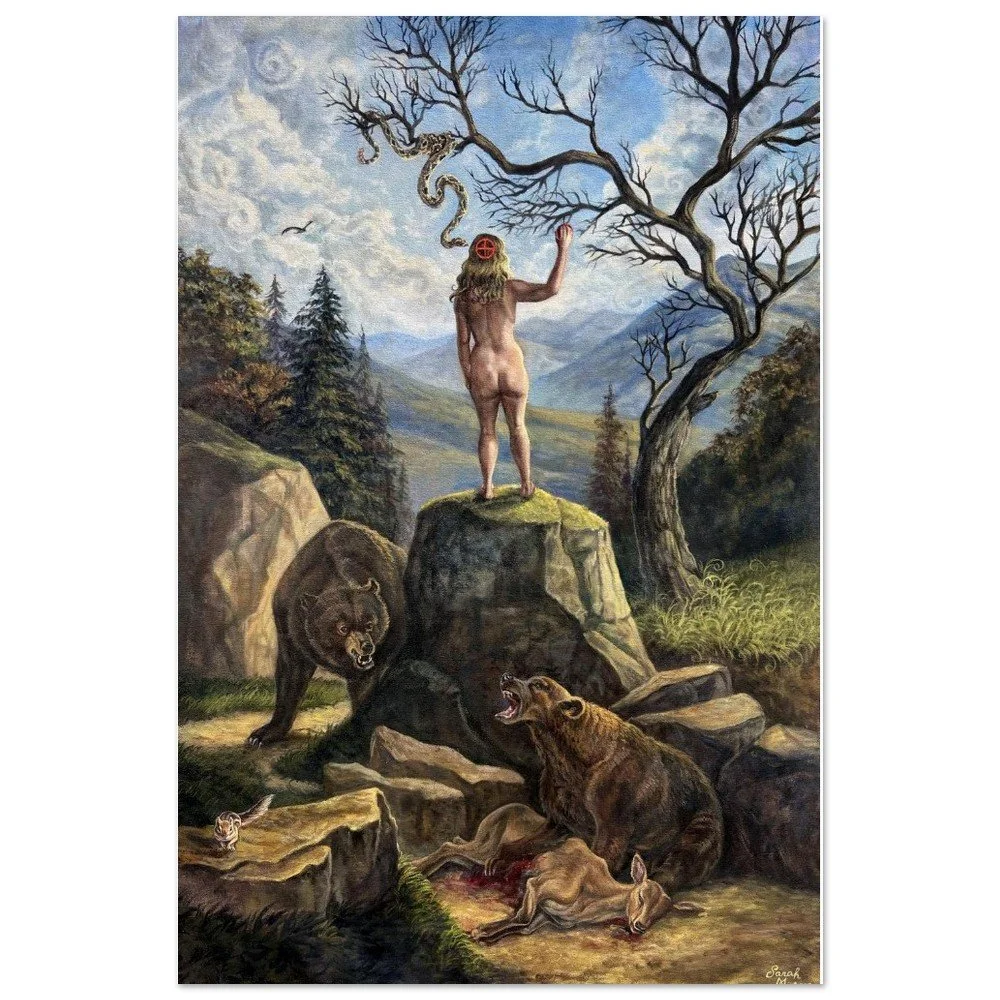 Image 1 of 7
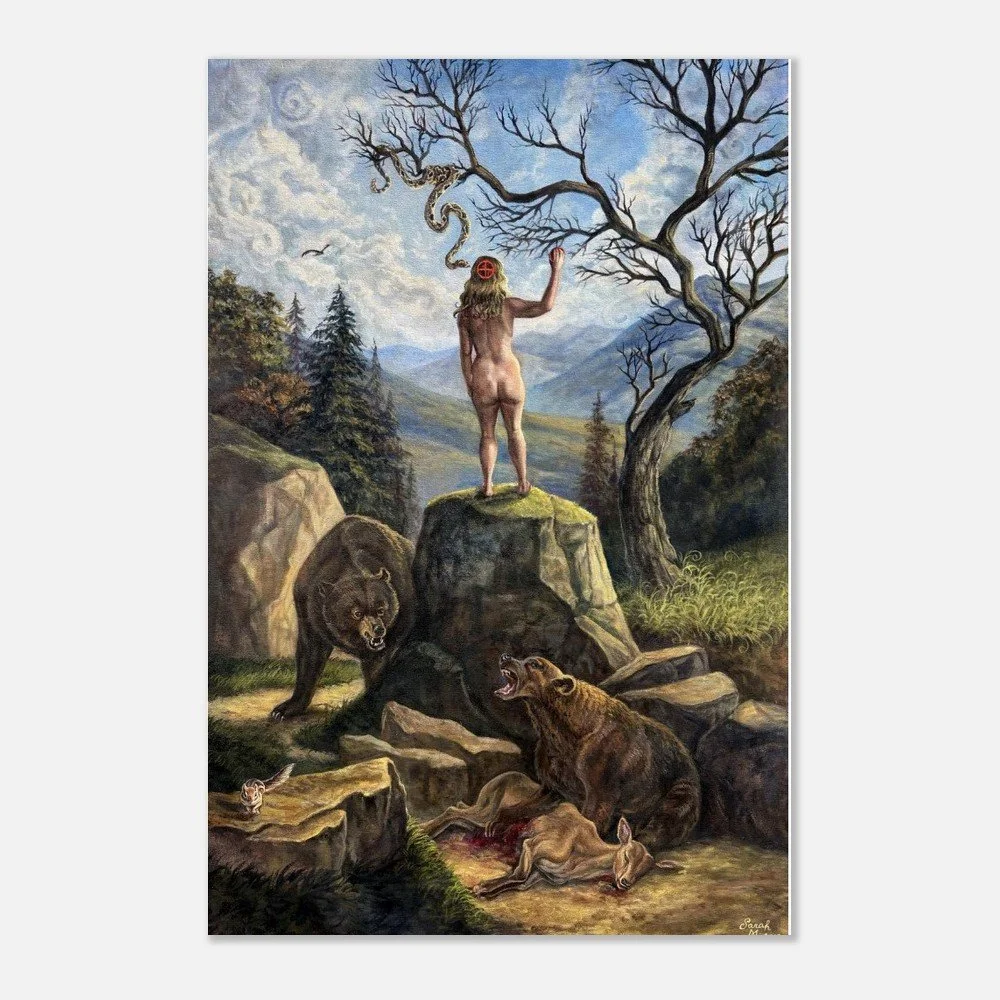 Image 2 of 7
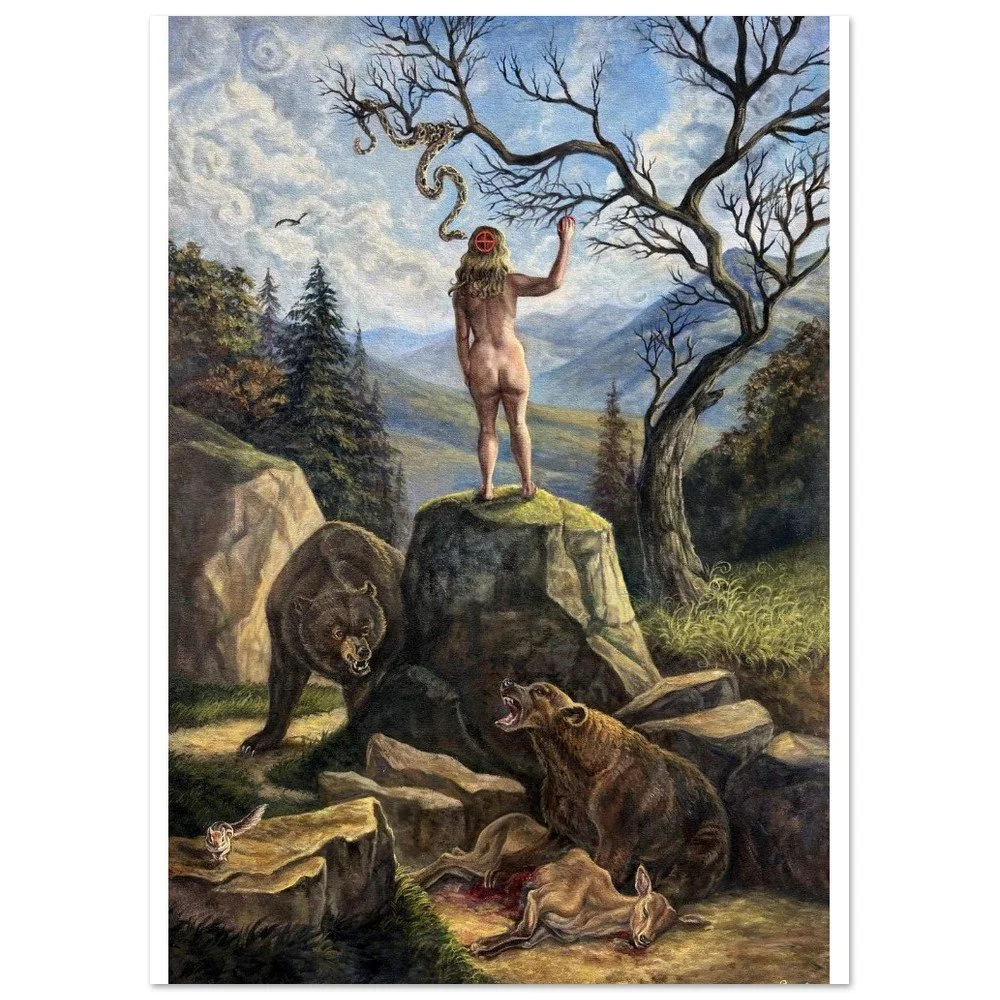 Image 3 of 7
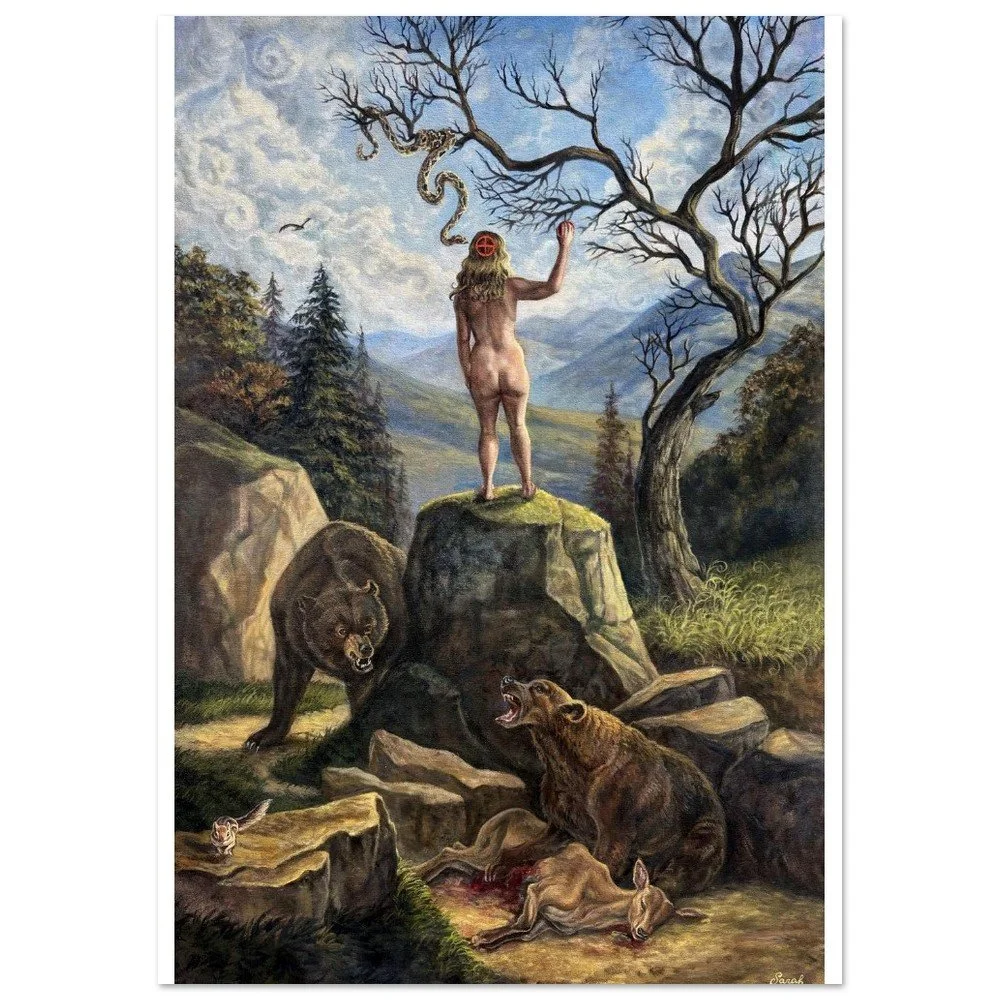 Image 4 of 7
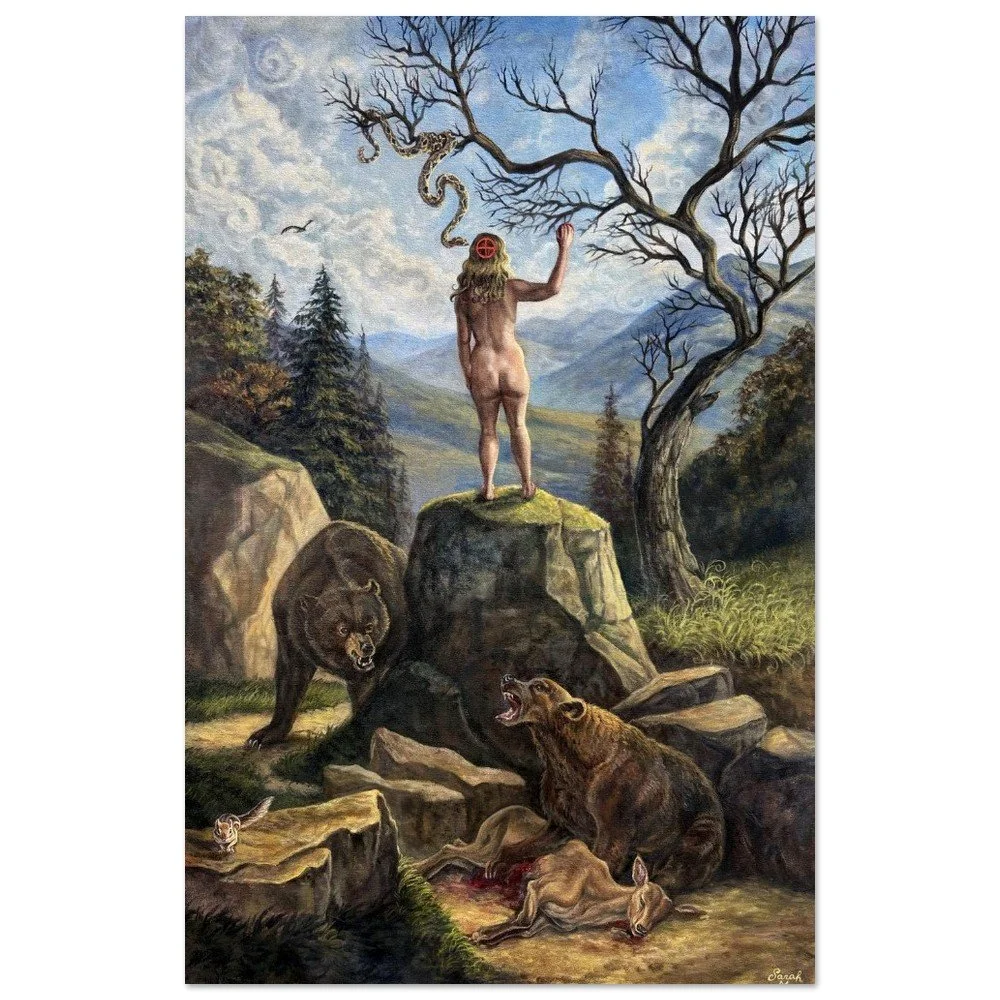 Image 5 of 7
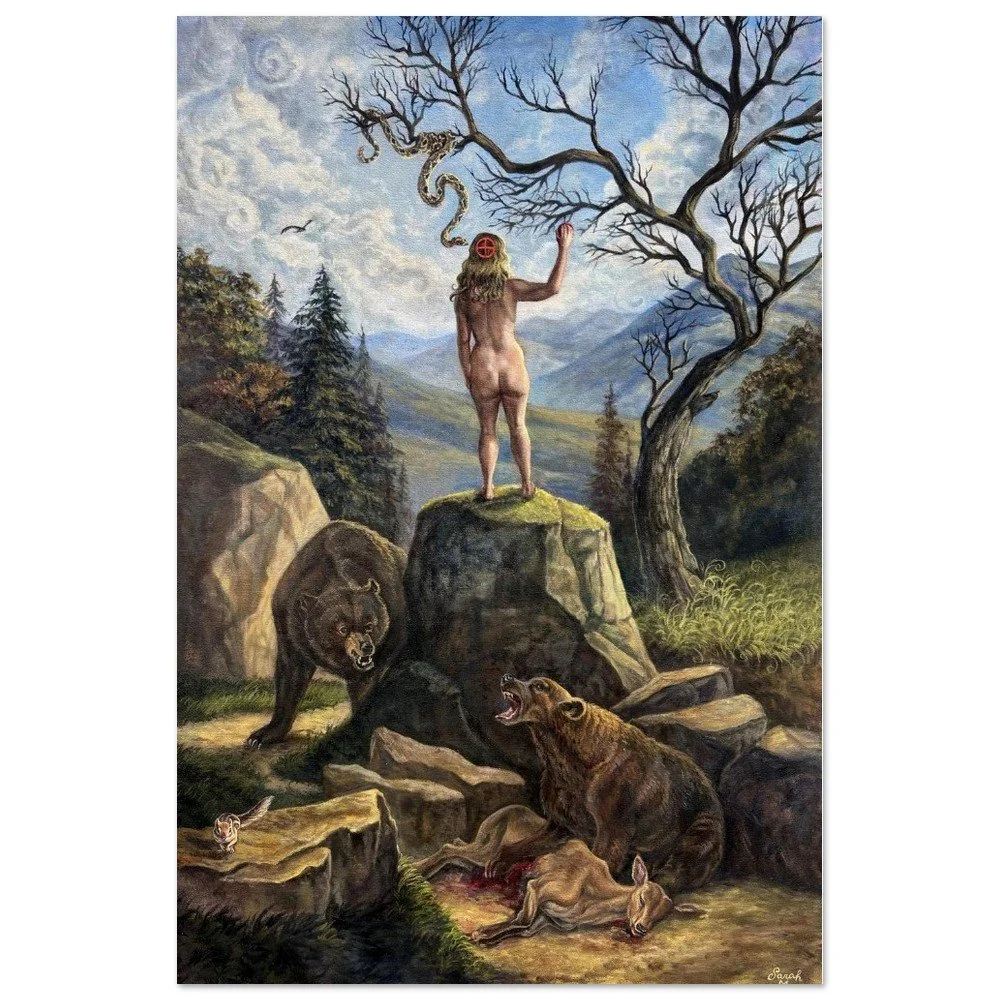 Image 6 of 7
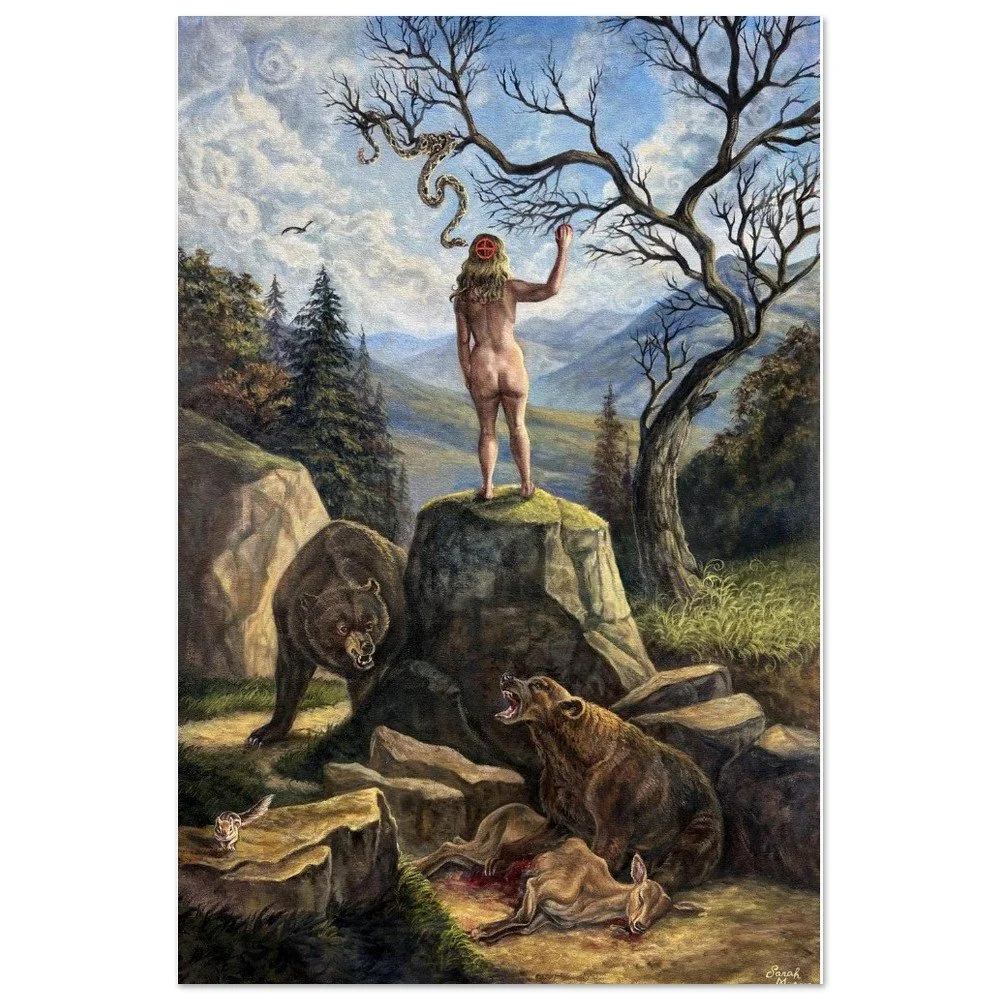 Image 7 of 7